 |
| http://www.sonofthesouth.net/leefoundation/civil-war/1861/February/davis-stephens.jpg |
Wednesday, February 13, 2013
Election of 1860
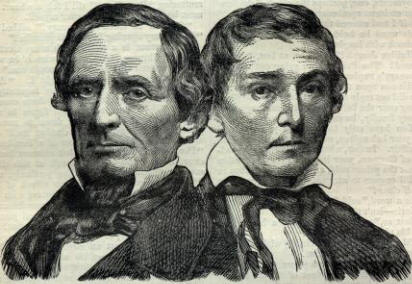
In the election of 1860, three candidates were running. Two Democratic Party representatives and one Republican Party representative. The republican representitive was Abraham Lincoln. Because there was a split of votes for the Democratic representatives, Abraham Lincoln won. He knew that either the United States would either ban slavery from the whole country, or allow it everywhere. The Southern states were very unhappy about the outcome of the election. The reactions were started by South Carolina when they suceeded from the Union on December 20, 1860. Georgians were split. The secessionists wanted to leave right away while the cooperationists did not. The final desicion ended up being that Georgia suceeded and joined the confederacy along with Alabama, Mississippi, South Carolina, Louisiana, Texas, Virginia, Arkansas, and North Carolina. The president of the Confederacy was Jefferson Davis and the vice president was Alexander Stephens.
Alexander Stephens was a cooperationist but knew that there was no way about getting around succession. The reason they hired a cooperationist and a secessionist was to keep order and balance so that everyone felt they were being represented. Davis and Stephens were close at first, but when Stephens became more focused on military efforts, their relationship weakened.

Sunday, February 10, 2013
Dred Scott
| http://en.wikipedia.org/wiki/Dred_Scott |
Leading Events
Overtime there were many new political disputes causing the tension between the North and South. It started off with the Missouri Compromise. Since the North and South disagreed on the feelings of slavery, they needed a balance of free states and slave states to be fair. Missouri and Maine both wanted to join the union and they could because there were two of them. Missouri was entered as a slave state, and Maine was entered as a free state. Then, the Missouri Compromise line was drawn dividing free states and slave states. 
http://teachers.henrico.k12.va.us/tucker/strusky_m/webquests/VUS6_madisonmonroe/MissouriCompromise.html
One of the next disputes was the tariff set on imported goods in 1812. This tariff was set on products from Great Britain such as tea, coffee, sugar, molasses, and other items. Southerners found this tariff to be unfair and believed the government was siding with the North. In response, John Calhoun from South Carolina declared that states should have the right to nullify federal laws. The government disagreed and tensions rose, but eventually, the taxes lowered. Today, states still can not override federal laws under any circumstances. Then, in 1850, California started to become popular because of the gold rush and also wanted to join the Union. The only problem was that if it did join, there would be more free states than slave states. At this time Texas had just won the war against Mexico and also wanted to join, but was in debt. The compromise was that if the USA paid Texas's debt, then Texas could join, but would have to split up into five states which turned into New Mexico, Arizona, Utah, Nevada, and Texas. The South was okay with this compromise because it allowed potential for four new states that could become slave states. Tensions were slowly starting to decrease when the Fugitive Slave Act, and Kansas-Nebraska Act came along. The Fugitive Slave Act meant that Northerners had to help slave catchers that were looking for runaway slaves in the North. The Kansas-Nebraska Act repealed the law about having the line between the slave states and free states, which meant that slavery could be allowed in Nebraska and Kansas if citizens voted for it. These both made Northern abolitionists mad, while pleasing Southerners. Kansas soon became known as "Bleeding Kansas"and became a battleground between Northerners and Southerners. http://www.pbs.org/wgbh/aia/part4/4p2952.html
http://teachers.henrico.k12.va.us/tucker/strusky_m/webquests/VUS6_madisonmonroe/MissouriCompromise.html
One of the next disputes was the tariff set on imported goods in 1812. This tariff was set on products from Great Britain such as tea, coffee, sugar, molasses, and other items. Southerners found this tariff to be unfair and believed the government was siding with the North. In response, John Calhoun from South Carolina declared that states should have the right to nullify federal laws. The government disagreed and tensions rose, but eventually, the taxes lowered. Today, states still can not override federal laws under any circumstances. Then, in 1850, California started to become popular because of the gold rush and also wanted to join the Union. The only problem was that if it did join, there would be more free states than slave states. At this time Texas had just won the war against Mexico and also wanted to join, but was in debt. The compromise was that if the USA paid Texas's debt, then Texas could join, but would have to split up into five states which turned into New Mexico, Arizona, Utah, Nevada, and Texas. The South was okay with this compromise because it allowed potential for four new states that could become slave states. Tensions were slowly starting to decrease when the Fugitive Slave Act, and Kansas-Nebraska Act came along. The Fugitive Slave Act meant that Northerners had to help slave catchers that were looking for runaway slaves in the North. The Kansas-Nebraska Act repealed the law about having the line between the slave states and free states, which meant that slavery could be allowed in Nebraska and Kansas if citizens voted for it. These both made Northern abolitionists mad, while pleasing Southerners. Kansas soon became known as "Bleeding Kansas"and became a battleground between Northerners and Southerners. http://www.pbs.org/wgbh/aia/part4/4p2952.html
Tuesday, February 5, 2013
Slavery
Slaves had to live through many tough conditions from the day they were born till they died. They got their first task at age 10. In Georgia, most slaves either worked in either cotton or rice plantations or as house servants. House servants were usually treated better than the plantation slaves because house slaves went out in public, and owners did not want their slaves to look bad. Slaves also couldn't get legally married, so when they did, they could be separated from their spouse at auctions. Some owners preferred to keep slave couples together so they could have children which meant more slaves without a cost for owners. Slaves also had many rules to live by. They weren't allowed to learn how to read or write, they couldn't be employed, and if they ever wanted to go anywhere they needed to have a pass signed by their owner, kind of like at school. The consequences were inhumane, including death and public whipping. Some slaves became so angry that they went to the extreme measure. One lady even cut off her own fingers so she wouldn't have to work. Slaves longed for freedom and equality so many started escaping using the underground railroad. The underground railroad consisted of many "stations" which were homes where slaves could hide, rest, eat, and stay before leaving to go further north to the next station. Along the railroad were conductors who were people that helped the slaves get to freedom. One of the most famous conductors was Harriet Tubman who after freeing herself, returned nineteen times to free over 200 people including her whole family.

Subscribe to:
Posts (Atom)